

Intervertebral Disc

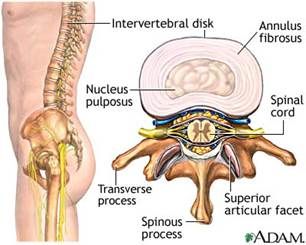
Our intervertebral discs allow the human spine to have flexible movement and also act as shock absorbers or cushions for our spine.
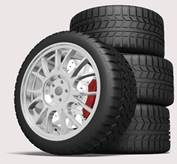
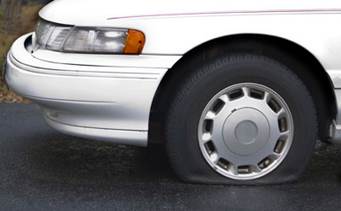
The center and interior of the disc consist of a core filled with water and gel (similar to the inner tube of a car tire), while the periphery is an outer ring-shaped fibrous layer (like the rubber outer layer of a tire).

A young and healthy intervertebral disc

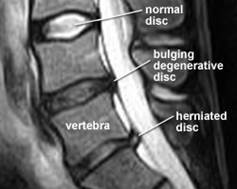
In many ways, an intervertebral disc is similar to a car tire. As long as the disc remains young and well-hydrated, it has enough internal pressure to support our body weight. A young and healthy disc appears white on a T2-weighted MRI image and has a normal thickness.

An aging and unhealthy intervertebral disc

However, due to various reasons such as:

  1. Natural aging and degeneration of the human body after the age of 27
  2. Long-term wear and tear of the discs: daily activities such as sitting for long periods, heavy lifting, and the impact pressure or twisting of the spine during exercise, etc.
  3. Spinal injuries: injuries from sports or housework, occupational injuries, accidental injuries, etc.

The reasons mentioned above cause the gel-filled core at the center of the disc to dehydrate and dry out (changing from white to gray or black on T2-weighted MRI images, with a decrease in thickness). Its internal pressure and support also decrease, making it like an aging, flat car tire.

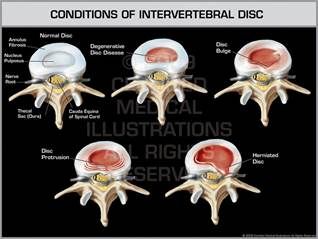
Under the pressure of body weight and daily activities, the outer ring-shaped fibrous layer of the disc wall (like the rubber outer layer of a tire) begins to thin and develop cracks—just as one sees when a car tire loses air and becomes flat. From then on, various spinal problems and symptoms begin:

Conditions of intervertebral disc

Symptoms that may result from various spinal problems include:

  1. Cervical spine problems may cause feelings of dizziness or nausea.
  2. The spine becomes stiff and straight.
  3. Central axial pain: headaches, neck pain, lower back pain, etc.
  4. Nerve root compression pain: pain in the head, shoulders, hands, buttocks, or legs, such as sciatica, etc.
  5. Sensory disturbances from nerve root compression: numbness, tingling, pins and needles, or weakened sensation in the shoulders, limbs, buttocks, etc.
  6. Motor disturbances from nerve root compression: localized muscle weakness in the limbs.
  7. Abnormal gait: limping, unstable posture, feet easily dragging on the ground while walking, instability, and imbalance, etc.
  8. High frequency and weakness of urination, frequent nocturia, or even urinary incontinence, etc.
  9. Constipation or weak bowel movements, or even fecal incontinence, etc.
  10. Impact on sexual function or male erectile dysfunction, etc.
error: Content is protected !!